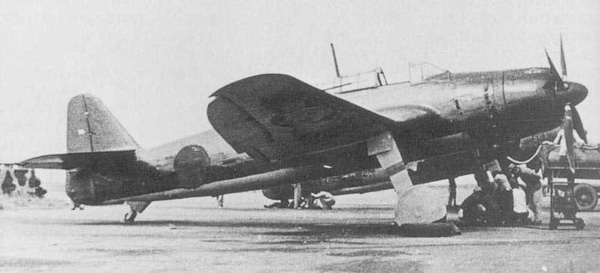
Yokosuka D4Y Suisei

The Yokosuka D4Y Suisei was a dive bomber of the Imperial Japanese Navy. Its Allied reporting name was "Judy". The D4Y was one of the fastest dive-bombers in the entire war, and only the delays in its development hindered its service, while its predecessor, the more robust but slower Aichi D3A remained in service for years. Despite this limited use, the speed and the range of the D4Y was nevertheless valuable, and the type was used with success as reconnaissance aircraft as well as in kamikaze missions.


Production of the D4Y1-C continued in small numbers until March 1943, when the increasing losses incurred by the D3A resulted in production switching to the D4Y1 dive-bomber, the aircraft's structural problems finally being solved. Although the D4Y could operate successfully from the large and fast fleet carriers that formed the core of the Combined Fleet at the start of the war, it had problems operating from the smaller and slower carriers such as the Hiyō class which formed a large proportion of Japan's carrier fleet after the losses received in the Battle of Midway. Catapult equipment was therefore fitted, giving rise to the D4Y-1 Kai model.

The last version was the D4Y4 Special Strike Bomber. This one-seat kamikaze aircraft, capable of carrying one 800 kg (1,760 lb) bomb, was put into production in February 1945. It was equipped with three RATO boosters for terminal dive acceleration. This aircraft was an almost ideal kamikaze model: it had a combination of speed (560 km/h/350 mph), range (2,500 km/1,550 mi) and payload (800 kg/1,760 lb) probably not matched by any other Japanese aircraft.


The D4Y5 Model 54 was a planned version designed in 1945. It was to be powered by the Nakajima NK9C Homare 12 radial engine rated at 1,361 kW (1,825 hp), would have a new four-blade metal propeller of the constant-speed type, and would have more armour protection for the crew and fuel tanks. Ultimately, 2,038 of all variants were produced, mostly by Aichi.

The D4Y was actually faster than the A6M Zero. Some were employed as D4Y2-S night fighters against the high flying B-29 Superfortress bombers late in the war, a unique role for a single-engine dive bomber. The night fighter conversions were made at the 11th Naval Aviation Arsenal at Hiro. Each D4Y2-S had all bomb equipment removed and a 20 mm Type 99 Model 2 cannon with its barrel slanting up and forwards (similar to the German Schräge Musik system) installed in place of the gunner's cockpit. However, the lack of radar for night operations and slow climb rate, combined with the B-29's high ceiling, made the D4Y2-S ineffective as a night fighter. Little is known of their operations.


General characteristics
  • Crew: two
  • Length: 33 ft 6 in (10.22 m)
  • Wingspan: 37 ft 9 in (11.50 m)
  • Height: 12 ft 3 in (3.74 m)
  • Wing area: 254 ft² (23.6 m²)
  • Empty weight: 5,379 lb (2,440 kg)
  • Loaded weight: 9,370 lb (4,250 kg)
  • Powerplant: 1× Aichi Atsuta AE1P 32 liquid-cooled inverted V12 piston engine, 1,044 kW (1,400 hp)

Performance
  • Maximum speed: 550 km/h (342 mph)
  • Range: 1,465 km (910 mi)
  • Service ceiling: 10,700 m (35,105 ft)
  • Rate of climb: 14 m/s (2,700 ft/min)
  • Wing loading: 180 kg/m² (37 lb/ft²)
  • Power/mass: 0.25 kW/kg (0.15 hp/lb)

Armament
  • 2× forward-firing 7.7 mm machine guns
  • 1× rearward-firing 7.92 mm machine gun
  • 500 kg (1,102 lb) of bombs (design), 800 kg (1,764 lb) of bombs


** Yokosuka D4Y Suisei - Warbird Fare

Yokosuka P1Y Ginga

The Yokosuka P1Y Ginga (Galaxy) was a twin-engine, land-based bomber developed for the Japanese Imperial Navy in World War II. It was the successor to the Mitsubishi G4M and given the Allied reporting name "Frances".


The P1Y was designed by the Yokosuka Naval Air Technical Arsenal to Navy specification 15-Shi, calling for a fast bomber with speed matching the Zero, range matching the G4M, a 907 kg (2,000 lb) bombload, and the ability to dive-bomb as well as carry torpedoes. As the result, the construction suffered from excess complexity, difficulty of manufacture, and poor serviceability. Problems with the availability of enough reliable Nakajima Homare engines led to their replacement by the Mitsubishi Kasei in the P1Y2-S night-fighter version.


The first flight was in August 1943. Nakajima manufactured 1,002 examples, which were operated by five Kokutais (Air Groups), and acted as land-based medium and torpedo bombers from airfields in China, Taiwan, Marianas, Philippines, Ryukyu, Shikoku, and Kyūshū. During the last stages of the war the P1Y was utilized as a kamikaze aircraft against the United States Navy during the Okinawa Campaign in Operation Tan No. 2.

A night fighter version, the P1Y2-S Kyokko (Aurora), with Mitsubishi Kasei engines, was equipped with radar and Schräge Musik style (upward firing as well as forward firing) 20 mm cannon. A total of 96 were produced by Kawanishi, but due to inadequate high-altitude performance against B-29s, many were converted back to Ginga bombers.


General characteristics
  • Crew: 3
  • Length: 15.00 m (49 ft 2⅜ in)
  • Wingspan: 20.00 m (65 ft 7¼ in)
  • Height: 4.30 m (14 ft 1¼ in)
  • Wing area: 55 m² (592 ft²)
  • Empty weight: 7,265 kg (16,020 lb)
  • Loaded weight: 10,500 kg (23,149 lb)
  • Max takeoff weight: 13,500 kg (29,762 lb)
  • Powerplant: 2 × Nakajima NK9C Homare 12 18-cylinder radial engines, 1,361 kW (1,825 hp)

Performance
  • Maximum speed: 547 km/h (295 knot, 340 mph) at 5,900 m (19,400 ft)
  • Cruise speed: 370 km/h (200 knots, 230 mph) at 4,000 m (13,125 ft)
  • Range: 5,370 km (2,900 nmi, 3,337 mi)
  • Service ceiling: 9,400 m (30,840 ft)
  • Wing loading: 191 kg/m² (39.1 lb/ft²)
  • Power/mass: 0.20 kW/kg (0.16 hp/lb)

Armament
  • 1× flexible, nose-mounted 20 mm Type 99 cannon
  • 1× flexible rear-firing 13 mm Type 2 machine gun
  • 1× 1,000 kg (2,205 lb) of bombs or
  • 1× 800 kg (1,800 lb) torpedo

** Yokosuka P1Y Ginga - Warbird Fare

Aichi B7A Ryusei

The Aichi B7A Ryusei (Shooting Star) Allied reporting name "Grace" was a large and powerful carrier-borne torpedo-dive bomber produced by Aichi Kokuki KK for the Imperial Japanese Navy Air Service during the Second World War. Built in only small numbers and deprived of the aircraft carriers it was intended to operate from, the type had little chance to distinguish itself in combat before the war ended in August 1945.


the B7A first flew as a prototype in May 1942, but teething problems with the experimental NK9C Homare engine and necessary modifications to the airframe meant that the type did not enter into production until two years later in May 1944. 9 prototype B7A1s were built and 80 production version B7A2s completed by Aichi before a severe earthquake in May 1945 destroyed the factory at Funakata where they were being assembled. A further 25 examples were produced at the 21st Naval Air Arsenal at Omura.

In June 1944, IJN Taihō, the only Imperial Japanese Navy aircraft carrier then large enough to operate the B7A Ryusei in its intended role, was sunk during the Battle of the Philippine Sea before enough B7As were even available to embark. Thereafter, the B7A was relegated to operating from land bases, primarily with the Yokosuka and 752nd Kokutais. The Japanese completed only one other carrier capable of operating the B7A, IJN Shinano, but she was sunk by an American submarine in November 1944, just ten days after being commissioned.


General characteristics
  • Crew: 2
  • Length: 11.49 m (37 ft 8.33 in)
  • Wingspan: 14.40 m (47 ft 3 in)
  • Height: 4.07 m (13 ft 4.5 in)
  • Wing area: 35.40 m² (381.041 ft²)
  • Empty weight: 3,810 kg (8,400 lb)
  • Loaded weight: 5,625 kg (12,401 lb)
  • Max takeoff weight: 6,500 kg (14,330 lb)
  • Powerplant: 1 × Nakajima NK9C Homare 12 18-cylinder air-cooled radial engine, 1,360 kW (1,825 hp)

Performance
  • Maximum speed: 567 km/h (306 kn, 352 mph)
  • Range: 3,038 km (1,888 mi)
  • Service ceiling: 11,250 m (36,910 ft)
  • Rate of climb: 9.6 m/s (1,889.8 ft/min)
  • Wing loading: 158.9 kg/m² (32.5 lb/ft²)
  • Power/mass: 0.24 W/kg (0.147 hp/lb)

Armament
  • 2× 20 mm Type 99 Model 2 cannons in wings
  • 1× 7.92 mm (0.312 in) Type 1 or
  • 1× 13 mm (0.51 in) Type 2 machine gun in the rear cockpit
  • 800 kg (1,764 lb) of general ordnance or
  • 1× 800 kg (1,764 lb) torpedo


** Aichi B7A Ryusei - Warbird Fare

Aichi D3A Val

The Aichi D3A, Allied reporting name "Val" was a World War II carrier-borne dive bomber of the Imperial Japanese Navy. It was the primary dive bomber in the Imperial Japanese Navy, and participated in almost all actions, including Pearl Harbor. The Aichi D3A was the first Japanese aircraft to bomb American targets in World War II, commencing with Pearl Harbor and US bases in the Philippines, such as Clark Air Force Base. During the course of the Second World War, the Val dive bomber sank more Allied warships than any other Axis aircraft.


Armament was two forward-firing 7.7 mm (.303 in) Type 97 machine guns, and one flexible 7.7 mm (.303 in) Type 92 machine gun in the rear cockpit for defense. Normal bombload was a single 250 kg (550 lb) bomb carried under the fuselage, which was swung out under the propeller on release by a trapeze. Two additional 60 kg (130 lb) bombs could be carried on wing racks located under each wing outboard of the dive brakes.


Starting with the attack on Pearl Harbor, the D3A1 took part in all major Japanese carrier operations in the first 10 months of the war. They achieved their first major success against the Royal Navy during their Indian Ocean raid in April 1942. Val dive bombers scored over 80% hits with their bombs during attacks on two heavy cruisers and an aircraft carrier during the operation. During the course of the war, Val dive bombers had to frequently combine their attacks upon enemy warships with the IJN Kate torpedo plane; consequently enemy vessels were often sunk by a combination strike of bombs and torpedoes.


General characteristics
  • Crew: Two (pilot and gunner)
  • Length: 10.2 m (33 ft 5 in)
  • Wingspan: 14.37 m (47 ft 2 in)
  • Height: 3.85 m (12 ft 8 in)
  • Wing area: 34.9 m² (375.6 ft²)
  • Empty weight: 2,408 kg (5,309 lb)
  • Max takeoff weight: 3,650 kg (8,047 lb)
  • Powerplant: 1× Mitsubishi Kinsei 44, 798 kW (1,070 hp)

Performance
  • Maximum speed: 389 km/h (205 kn, 242 mph)
  • Range: 1,472 km (795 nmi, 915 mi)
  • Service ceiling: 9,300 m (30,500 ft)

Armament
  • 2 × fixed, forward-firing 7.7 mm (0.303 in) Type 97 machine guns
  • 1 × flexible, rearward-firing 7.7 mm (0.303 in) Type 92 machine gun
  • 1 × 250 kg (551 lb) or 2 × 60 kg (132 lb) bombs


** Aichi D3A Val - Warbird Fare

Heinkel He 112

The Heinkel He 112 was a fighter aircraft designed by Walter and Siegfried Günter. It was one of four aircraft designed to compete for the Luftwaffe's 1933 fighter contract. Small numbers were used for a short time by the Luftwaffe, and small runs were completed for several other countries, but less than 100 were completed in total. It remains one of the least known production fighter designs.


The first prototype, He 112 V1, was completed on 1 September 1935, but as the planned Junkers Jumo 210 engine was unavailable, a 518 kW (695 hp) Rolls-Royce Kestrel Mk IIS was fitted. Initial test flights at the factory revealed that drag was much higher than expected, and that the aircraft was not going to be as fast as originally predicted. The V1 was sent off to be tested by the Reichsluftfahrtministerium (RLM) in December at Travemünde.

The second prototype, V2, was completed on 16 November. It had the 477 kW (640 hp) Jumo 210C engine and a three-blade propeller, but was otherwise identical to the V1. Meanwhile, the data from the V1 factory flights was studied to discover where the unexpected drag was coming from. The Günter brothers identified the large, thick wing as the main culprit, and designed an entirely new smaller and thinner wing with an elliptical planform. As a stop-gap measure, V2 had its wings clipped by 1.010 m (3 ft 7 in) to allow it to compete with the 109. This made the He 112 creep over the wing loading requirements in the specifications, but with the 109 way over the limit, this was not seen as a problem, and the V2 was sent off for testing.

The V3 took to the air in January. Minor changes included a larger radiator, fuselage spine and vertical stabilizer, but it was otherwise largely the same as the clipped wing V2. Other changes included a single cover over the exhaust ports instead of the more common "stack", and it also included modifications to allow the armament to be installed in the cowling. It was expected to join the V2 in testing, but instead was assigned back to Heinkel in early 1937 for tests with rocket propulsion. During a test, the rocket exploded and the aircraft was destroyed, but in an amazing effort the V3 was rebuilt with several changes, including an enclosed cockpit.

The He 112 V1 started in the head-to-head contest when it arrived at Travemünde on 8 February 1936. The other three competitors had all arrived by the beginning of March. Right away, the Focke-Wulf Fw 159 and Arado Ar 80 proved to be lacking in performance, and plagued with problems, and were eliminated from serious consideration.


At this point, the He 112 was the favorite over the "unknown" Bf 109, but opinions changed when the Bf 109 V2 arrived on 21 March. All the competitor aircraft had initially been equipped with the Rolls-Royce Kestrel engine, but the Bf 109 V2 had the Jumo. From that point on, it started to outperform the He 112 in almost every way, and even the arrival of the Jumo-engined He 112 V2 on 15 April did little to address this imbalance.

Testing continued until October, at which point some of the additional zero series aircraft had arrived. At the end of September, there were four He 112s being tested, yet none was a match for the Bf 109. From October on, the Bf 109 appears to have been selected as the winner of the contest.


General characteristics
  • Crew: 1
  • Length: 9.22 m (30 ft 11 7/8 in)
  • Wingspan: 9.09 m (29 ft 9¾ in)
  • Height: 3.82 m (12 ft 6¾ in)
  • Wing area: 17 m² (183 ft²)
  • Empty weight: 1,617 kg (3,565 lb)
  • Max takeoff weight: 2,248 kg (4,957 lb)
  • Powerplant: 1 × Junkers Jumo 210Ga liquid-cooled inverted V12 engine, 522 kW (700 hp)

Performance
  • Maximum speed: 510 km/h (317 mph)
  • Range: 1150 km (715 mi)
  • Service ceiling: 9,500 m (31,200 ft)
  • Wing loading: 132 kg/m² (27.1 lb/ft²)

Armament
  • 2 × 7.92 mm (.312 in) MG 17 machine guns with 500 rpg
  • 2 × 20 mm MG FF cannons with 60 rpg, in the wings


** Heinkel He 112 - Warbird Fare

Dewoitine D.520

The Dewoitine D.520 was a French fighter aircraft that entered service in early 1940, shortly after the opening of World War II. Unlike the Morane-Saulnier M.S.406, which was at that time the Armée de l'Air's most numerous fighter, the Dewoitine D.520 came close to being a match for the latest German types, such as the Messerschmitt Bf 109. It was slower than the Bf 109E but superior in manoeuvrability. Because of a delayed production cycle, only a small number were available for combat with the Luftwaffe.


The D.520 was designed in response to a 1936 requirement from the Armée de l'Air for a fast, modern fighter with a good climbing speed and an armament centred around a 20 mm cannon. At the time the most powerful V 12 liquid cooled engine available in France was the Hispano-Suiza 12Y, which was less powerful, but lighter, than contemporary engines such as the Rolls-Royce Merlin and Daimler-Benz DB 601. Other fighters were designed to meet the specifications but none of them entered service, or entered service in small numbers and too late to play a significant role during the Battle of France.


The Groupe de Chasse I/3 was the first unit to get the D.520, receiving its first aircraft in January 1940. These were unarmed and used for pilot training. In April and May 1940, operational units received 34 production D.520s; the type proving to be very popular with the pilots. In comparative trials on 21 April 1940 at CEMA at Orleans-Bricy against a captured Bf 109E-3, the German aircraft had a 32 km/h (20 mph) speed advantage owing to its more powerful engine. However, the D.520 had superior maneuverability, matching its turning circle, although displaying nasty characteristics when departing and spinning out of the turn repeatedly during the tests. The Bf 109, owing to its slats, could easily sustain the turn on the edge of a stall.


By 10 May 1940, when Germany invaded France and the Low Countries, 228 D.520s had been manufactured, but the Armée de l'Air had only accepted 75, as most others had been sent back to the factory to be retrofitted to the new standard. As a result, only GC I/3 was fully equipped, having 36 aircraft. They met the Luftwaffe on 13 May, shooting down three Henschel Hs 126s and one Heinkel He 111 without loss. Four more Groupes de Chasse and three naval Escadrilles rearmed with the type before France's surrender.

In air combat, mostly against Italians, the Dewoitine 520s claimed 114 air victories, plus 39 probables. Eighty five D.520s were lost. By the armistice at the end of June 1940, 437 D.520s had been built with 351 delivered. After the armistice, 165 D.520s were evacuated to North Africa. GC I/3, II/3, III/3, III/6 and II/7 flew their aircraft to Algeria to avoid capture. Three more, from GC III/7, escaped to Britain and were delivered to the Free French. A total of 153 D.520s remained in mainland France. One of the most successful D.520 pilots was Pierre Le Gloan, who shot down 18 aircraft (four Germans, seven Italian and seven British), scoring all of his kills with the D.520, and ranked as the fourth-highest French ace of the war.

A very small number of D.520s were briefly operated by Free French Forces for training purposes. Along with the three examples that had flown to Britain in June 1940, two other D.520s were recovered from retreating Vichy forces in Rayak, Lebanon. These D.520s were flown by pilots of the Normandie-Niemen unit before the unit was sent to the USSR, where they flew the Yakovlev Yak-1 that had many similarities with the D.520.

After the war, the D.520s that remained in France were used as trainers. One example was field-modified as a two-seater in late 1945. In March 1946, after further experiments, the Armée de l'air ordered a further batch of 20 D.520s to be converted; however, only 13 of these D.520 DC conversions were completed. The last flight of an operational D.520 was made on 3 September 1953 with EPAA (Esquadrille de Presentation de l'Armée de l'Air). Initially this unit had flown Yak-3s, formally of the Normandie-Niemen fighter squadron; these were later replaced with seven D.520s, three of them being two-seaters.


General characteristics
  • Crew: 1
  • Length: 8.6 m (28 ft 3 in)
  • Wingspan: 10.2 m (33 ft 5? in)
  • Height: 2.57 m (8 ft 5 in)
  • Wing area: 15.87 m² (171 ft²)
  • Empty weight: 2,123 kg (4,680 lb)
  • Loaded weight: 2,677 kg (5,902 lb)
  • Max takeoff weight: 2,785 kg (6,140 lb)
  • Powerplant: 1 × Hispano-Suiza 12Y-45 liquid-cooled V12 engine, 690 kW (930 hp)

Performance
  • Maximum speed: 560 km/h (302 kn, 347 mph)
  • Range: 1,250 km (675 nmi, 777 mi)
  • Service ceiling: 10,000 m (33,000 ft)
  • Rate of climb: 14.3 m/s (2,820 ft/min)
  • Wing loading: 167 kg/m² (34.2 lb/ft²)
  • Power/mass: 257 W/kg (0.156 hp/lb)

Armament
  • 1 × 20 mm Hispano-Suiza HS.404 (60-round drum) cannon
  • 4 × 7.5 mm (0.295 in) MAC 1934 (675 rpg) machine guns

** Dewoitine D.520 - Warbird Fare

Morane-Saulnier M.S.406

The M.S.406 was a French Armée de l'Air fighter aircraft built by Morane-Saulnier starting in 1938. Numerically it was France's most important fighter during the opening stages of World War II.


Although sturdy and highly maneuverable, it was under-powered and weakly-armed when compared to its contemporaries. Most critically, it was out-performed by the Messerschmitt Bf 109E during the Battle of France. The M.S.406 held its own in the early stages of the war, but when the war restarted in earnest in 1940, 387 were lost in combat or on the ground for 183 kills in return. The type was more successful in the hands of Finnish and Swiss air forces who developed indigenous models.


In late 1930s a war with Germany was clearly looming, and the Armée de l'Air placed an order for 1,000 airframes in March 1938. Morane-Saulnier was unable to produce anywhere near this number at their own factory, so a second line was set up at the nationalized factories of SNCAO at St. Nazaire converted to produce the type. Production began in late 1938, and the first production example flew on 29 January 1939. Deliveries were hampered more by the slow deliveries of the engines than by lack of airframes.

By April 1939, the production lines were delivering six aircraft a day, and when the war opened on 3 September 1939, production was at 11 a day with 535 in service. Production of the M.S.406 ended in March 1940, after the original order for 1,000 had been delivered to the Armée de l'Air, and a further 77 for foreign users. Additional orders for Lithuania and Poland were canceled with the outbreak of the war.

The MS 406 equipped 16 Groupes de Chasse and three Escadrilles in France and overseas, and 12 of the Groupes saw action against the Luftwaffe. The aircraft was very manoeuvrable and could withstand heavy battle damage, but was outclassed by the Bf 109 and losses were heavy. After the armistice, only one Vichy unit, GC. 1/7, was equipped with the MS. 406.

Germany took possession of a large number of M.S.406s and the later M.S.410s. The Luftwaffe used a number for training, and sold off others. Finland purchased additional M.S.406s (as well as a few 406/410 hybrids) from the Germans, while others were passed off to Italy and Croatia. Those still in French hands saw action in Syria against the RAF, and on Madagascar against the Fleet Air Arm. Both Switzerland and Turkey also operated the type; the Swiss actually managing to down a number of both German and Allied aircraft, 1944-1945. During the Pacific campaign, Vichy authorities in French Indochina were engaged in frontier fighting against Thai forces from 1940 to 1943. A number of M.S.406s stationed in Indochina downed Thai fighters before the French Air Force's eventual abandoning of the theatre in March 1943. Some examples of the M.S.406 were captured by the Thai Air Force.


General characteristics
  • Crew: one pilot
  • Length: 8.17 m (26 ft 9 in)
  • Wingspan: 10.62 m (34 ft 10 in)
  • Height: 2.71 m (8 ft 10 in)
  • Wing area: 17.10 m² (184.06 ft²)
  • Empty weight: 1,893 kg (4,173 lb)
  • Loaded weight: 2,426 kg (5,348 lb)
  • Powerplant: 1 × Hispano-Suiza 12Y31 liquid-cooled V-12, 640 kW (860 hp)

Performance
  • Maximum speed: 486 km/h (303 mph) at 5,000 m (16,400 ft)
  • Range: 1,000 km (620 mi)
  • Rate of climb: 13.0 m/s (2,560 ft/min)
  • Wing loading: 141.9 kg/m² (29.1 lb/ft²)
  • Power/mass: 260 W/kg (0.16 hp/lb)

Armament
  • 1× 20 mm Hispano-Suiza HS.404 cannon
  • 2× 7.5 mm MAC 1934 machine guns

** Morane-Saulnier M.S.406 - Warbird Fare

Potez 630

The Potez 630 and its derivatives were a family of twin-engined aircraft developed for the Armée de l'Air in the late 1930s. The design was a contemporary of the British Bristol Blenheim and the German Messerschmitt Bf 110.


The Potez 630's engines proved so troublesome that most units had re-equipped with the Potez 631 before World War two began. The latter was an ineffectual interceptor, slower than some German bombers and 130 km/h slower than the Bf 109E, although it continued in service until the armistice.


The Potez 633 saw only brief operational service with the Armée de l'Air in Europe when aircraft from two units undertook a sortie near Arras on May 20, 1940; two days later the aircraft was withdrawn from front-line service. The Potez 633 exported to Greece and Romania saw more extensive service, in limited numbers. The Romanians used them against the USSR and the Greeks against Italy. A small number of Potez 633 originally destined for China were commandeered by the French colonial administration in Indo-China and saw limited action in the brief French-Thai War in early 1941.

More than 700 Potez 63.11 were delivered by June 1940, of which more than 220 were destroyed or abandoned, despite the addition of extra machine gun armament; the heaviest losses of any French type. The Potez 63.11 continued in service with the Vichy air force and with the Free French forces in North Africa seeing action with both. Production was resumed under German control and significant numbers appear to have been impressed by the Germans, mostly in liaison and training roles.

All members of the family (possibly except the Potez 63.11) shared pleasant flying characteristics. They were well designed for easy maintenance and later models had a heavy armament for the time. They were also quite attractive aircraft. Although not heavily built they proved capable of absorbing considerable battle damage. Unfortunately the Potez 63 family, like many French aircraft of the time, simply did not have sufficiently powerful engines to endow them with an adequate performance. In the stern test of war they proved easy meat for prowling Messerschmitts, like their British contemporaries the Fairey Battle and Bristol Blenheim. Their similarity to the Bf 110 (twin engines, twin tail, long "glasshouse" canopy) was sufficient that some were apparently lost to "friendly fire".


General characteristics
  • Crew: three
  • Length: 10.93 m (35 ft 11 in)
  • Wingspan: 16.00 m (52 ft 6 in)
  • Height: 3.08 m (10 ft 1 in)
  • Wing area: 32.7 m² (352 ft²)
  • Empty weight: 3,135 kg (6,911 lb)
  • Loaded weight: 3,845 kg (8,488 lb)
  • Max takeoff weight: 4,530 kg (9,987 lb)

Performance
  • Maximum speed: 425 km/h (264 mph)
  • Range: 1,500 km (932 miles)
  • Service ceiling: 8,500 m (27,885 ft)
  • Rate of climb: 500 m/m (1,640 ft/min)
  • Wing loading: kg/m² (lb/ft²)

Armament
  • 1x fixed, forward-firing 7.5 mm MAC 1934 machine gun
  • 1x fixed, rearward-firing 7.5 mm MAC 1934 machine gun
  • 1x flexible, rearward-firing 7.5 mm MAC 1934 machine gun
  • 4x 50 kg (110 lb) bombs

** Potez 630 - Warbird Fare

Messerschmitt Me 163 Komet

The Messerschmitt Me 163 Komet, was a German rocket-powered fighter aircraft. It is the only rocket-powered fighter aircraft ever to have been operational. Its design was revolutionary, and the Me 163 was capable of performance unrivaled at the time. Messerschmitt test pilot Rudy Opitz in 1944 reached 1,123 km/h (698 mph). Over 300 aircraft were built, however the Komet proved ineffective as a fighter, having been responsible for the destruction of only about nine Allied aircraft.


The performance of the Me 163 far exceeded that of contemporary piston engine fighters. At a speed of over 320 km/h (200 mph) the aircraft would take off, in a "sharp start" from the ground, from its two-wheeled dolly. The aircraft would be kept at low altitude until the best climbing speed of around 676 km/h (420 mph) was reached, at which point it would jettison the dolly, pull up into a 70° angle of climb, and rapidly climb to a bomber's altitude. It could go higher if required, reaching 12,000 m (39,000 ft) in an unheard-of three minutes. Once there, it would level off and quickly accelerate to speeds around 880 km/h (550 mph) or faster, which no Allied fighter could match. The usable Mach number was similar to the Me-262, but because of the high thrust to drag ratio, it was much easier for the pilot to lose track of the onset of severe compressibility and loss of control. A Mach warning system was installed as a result. The aircraft was remarkably agile and docile to fly at high speed. According to Rudolf Opitz, chief test pilot of the Me 163, it could "fly circles around any other fighter of its time".


In service, the Me 163 turned out to be difficult to use against enemy aircraft. Its tremendous speed and climb rate meant a target was reached and passed in a matter of seconds. Although the Me 163 was a stable gun platform, it required excellent marksmanship to bring down an enemy bomber. The Komet was equipped with two 30 mm (1.18 inch) MK 108 cannons which had a relatively low muzzle velocity, with the characteristic ballistic drop of such a weapon. The drop meant they were only accurate at short distance, and that it was almost impossible to hit a slow-moving bomber when the Komet was traveling very fast. Four or five hits were typically needed to take down a B-17.

A number of innovative solutions were implemented to ensure kills by less experienced pilots. The most promising was a unique weapon called the Sondergerät 500 Jägerfaust. This consisted of a series of single-shot, short-barreled 50 mm (2-inch) guns pointing upwards. Five were mounted in the wing roots on each side of the aircraft. The trigger was tied to a photocell in the upper surface of the aircraft, and when the Komet flew under the bomber, the resulting change in brightness caused by the underside of the aircraft could cause the rounds to be fired. As each shell shot upwards, the disposable gun barrel that fired it was ejected downwards, thus making the weapon recoilless. It appears that this weapon was used in combat only once, resulting in the destruction of a Halifax bomber, though other sources say it was a Boeing B-17.

Capt. Eric Brown RN, Chief Naval Test Pilot and commanding officer of the Captured Enemy Aircraft Flight, said, "The Me 163 was an aeroplane that you could not afford to just step into the aircraft and say 'You know, I’m going to fly it to the limit.' You had very much to familiarise with yourself with it because it was state-of-the-art and the technology used."


General characteristics
  • Crew: 1
  • Length: 5.70 m (18 ft 8 in)
  • Wingspan: 9.33 m (30 ft 7 in)
  • Height: 2.75 m (9 ft 0 in)
  • Wing area: 18.5 m² (200 ft²)
  • Empty weight: 1,905 kg (4,200 lb)
  • Loaded weight: 3,950 kg (8,710 lb)
  • Max takeoff weight: 4,310 kg (9,500 lb)
  • Powerplant: 1 × Walter HWK 109-509A-2 liquid-fuel rocket, 17 kN (3,800 lbf)

Performance
  • Maximum speed: 1,060 km/h (596 mph)
  • Range: 40 km (25 mi)
  • Service ceiling: 12,100 m (39,700 ft)
  • Rate of climb: 160 m/s (31500 ft/min)
  • Wing loading: 213 kg/m² (43 lb/ft²)
  • Thrust/weight: 0.42

Armament
  • 2 × 30 mm (1.18 in) Rheinmetall Borsig MK 108 cannons

** Messerschmitt Me 163 Komet - Warbird Fare

Dornier Do 335 Pfeil

The Dornier Do 335 Pfeil (Arrow) was a World War II heavy fighter built by the Dornier company. The Pfeil's performance was much better than other twin-engine designs due to its unique "push-pull" layout and the much lower drag of the in-line alignment of the two motors. The Luftwaffe was desperate to get the design into operational use, but delays in engine deliveries meant only a handful were delivered before the war ended.


There are many advantages to this design over the more traditional system of placing one engine on each wing, the most important being power from two engines with the frontal area (and thus drag) of a single-engine design, allowing for higher performance. It also keeps the weight of the twin powerplants near, or on, the aircraft centerline, increasing the roll rate compared to a traditional twin. In addition, a single engine failure does not lead to asymmetric thrust, and in normal flight there is no net torque so the plane is easy to handle. The choice of a full "four-surface" set of cruciform tail surfaces in the Do 335's design, allowed the ventral vertical fin–rudder assembly to project downwards from the extreme rear of the fuselage, in order to protect the rear propeller from an accidental ground strike on takeoff.


First flew on 26 October 1943 under the control of Flugkapitän Hans Dieterle, a regular and primary Heinkel test pilot, were surprised at the speed, acceleration, turning circle, and general handling of the type; it was a twin that flew like a single.

French ace Pierre Clostermann claimed the first Allied combat encounter with a Pfeil in April 1945. He describes leading a flight of four Hawker Tempests from No. 3 Squadron RAF over northern Germany, when he intercepted a lone Do 335 flying at maximum speed at treetop level. Detecting the British aircraft, the German pilot reversed course to evade. Despite the Tempest's considerable low altitude speed, the RAF fighters were not able to catch up or even get into firing position.


At least 16 prototype Do 335s were known to have flown on a number of DB603 engines. The first preproduction Do 335, were delivered in July 1944. Approximately 22 preproduction aircraft were thought to have been completed and flown before the end of the war, including approximately 11 A-0s converted to A-11s for training purposes.


General characteristics
  • Crew: 1, pilot
  • Length: 45 ft 5 in (13.85 m)
  • Wingspan: 45 ft 1 in (13.8 m)
  • Height: 15 ft (4.55 m)
  • Wing area: 592 ft² (55 m²)
  • Empty weight: 11,484 lb (5,210 kg)
  • Max takeoff weight: 19,500 lb (8,590 kg)
  • Powerplant: 2× Daimler-Benz DB 603A 12-cylinder inverted engines, 1,287 kW, 1,726 hp (1,750 PS) each

Performance
  • Maximum speed: 474 mph (765 km/h)
  • Combat radius: 721 mi (1,160 km (half load))
  • Service ceiling: 37,400 ft (11,400 m)

Armament
  • 1 × 30 mm (1.18 in) MK 103 cannon
  • 2 × 20 mm MG 151 cannons
  • 1,000 kg (2,200 lb) bombload

** Dornier Do 335 Pfeil - Warbird Fare

Heinkel He 162 Volksjäger

The Heinkel He 162 Volksjäger (People's Fighter) was a German single-engine, jet-powered fighter aircraft fielded by the Luftwaffe in World War II. Designed and built quickly, and made primarily of wood as metals were in very short supply and prioritised for other aircraft, the He 162 was nevertheless the fastest of the first generation of Axis and Allied jets. Volksjäger was the Reich Air Ministry's official name for the He 162. Other names given to the plane include Salamander, which was the codename of its construction program, and Spatz (Sparrow), which was the name given to the plane by Heinkel.


Heinkel had designed a little aircraft, with a sleek, streamlined fuselage. The BMW 003 axial-flow turbojet was mounted in a pod nacelle uniquely situated atop the fuselage directly aft of the cockpit. Twin vertical tailfins were mounted at the ends of highly dihedralled horizontal tailplanes to clear the jet exhaust, a high-mounted straight wing with a forward-swept trailing edge and shallow dihedral, an ejection seat was provided for the pilot, and tricycle landing gear that retracted into the fuselage. The prototype flew within an astoundingly short period of time: the design was chosen on 25 September and first flew on 6 December, less than 90 days later. This was despite the fact that the factory in Wuppertal making Tego film plywood glue used in a substantial number of late-war German aviation designs that were meant to be constructed from wood had been bombed by the Royal Air Force and a replacement had to be quickly substituted.


The first flight of the He 162 V1, by Flugkapitän Gotthard Peter, was fairly successful, but during a high-speed run at 840 km/h (520 mph), the highly acidic replacement glue holding the nose gear cover on failed and the pilot was forced to land. Other problems were noted as well, notably a pitch instability and problems with slideslip due to the rudder design. Neither was considered important enough to hold up the production schedule for even a day. On a second flight on 10 December, again with Peter at the controls, in front of various Nazi officials, the glue again caused a structural failure. This allowed the aileron to separate from the wing, causing the plane to roll over and crash,

The He 162 was originally built with the intention of being flown by the Hitler Youth, as the Luftwaffe was fast running out of pilots. However, the aircraft was far too complicated for any but a highly experienced pilot. An unpowered two-seat glider version, designated the He 162S (Schulen), was developed for training purposes. Only a small number were built, and even fewer delivered to the sole He 162 Hitler Youth training unit to be activated (in March 1945) at an airbase at Sagan. The unit was in the process of formation when the war ended, did not begin any training, and it is doubtful that more than one or two He 162S gliders ever took to the air.


General characteristics
  • Crew: 1, pilot
  • Length: 9.05 m (29 ft 8 in)
  • Wingspan: 7.2 m (23 ft 7 in)
  • Height: 2.6 m (8 ft 6 in)
  • Wing area: 14.5 m² (156 ft²)
  • Empty weight: 1,660 kg (3,660 lb)
  • Max takeoff weight: 2,800 kg (6,180 lb)
  • Powerplant: 1 × BMW 003E-1 axial flow turbojet, 7.85 kN (1,760 lbf)

Performance
  • Maximum speed: 905 km/h at 6000 m. (562 mph)
  • Range: 975 km (606 mi)
  • Service ceiling: 12,000 m (39,400 ft)
  • Rate of climb: 1,405 m/min (4,615 ft/min)

Armament
  • 2 × 20 mm MG 151 cannons with 120 rpg (He 162 A-2) or
  • 2 × 30 mm MK 108 cannons with 50 rpg (He 162 A-0, A-1)

** Heinkel He 162 Volksjäger - Warbird Fare

Heinkel He 280

The Heinkel He 280 was the first turbojet-powered fighter aircraft in the world. It was inspired by Ernst Heinkel's emphasis on research into high-speed flight and built on the company's experience with the He 178 jet prototype. A combination of technical and political factors led to it being passed over in favor of the Messerschmitt Me 262. Only nine were built and none reached operational status.


The Heinkel company began the He 280 project on its own initiative after the He 178 had been met with indifference from the Reichsluftfahrtministerium (Reich Aviation Ministry). The head designer was Robert Lusser, who began the project under the designation He 180 in late 1939. It had a typical Heinkel fighter fuselage, elliptically-shaped wings and a dihedralled tailplane with twin fins and rudders. The landing gear was of the retractable tricycle type with very little ground clearance. Internally, the He 280 was equipped with a compressed-air powered ejection seat, the first aircraft to carry one.


A contest flight in 1941 comparing an He 280 with a Focke-Wulf Fw 190 had the He 280 completing four laps of an oval course before the Fw 190 could complete three. Ernst Heinkel designed a smaller jet fighter airframe for the He 280 that was well matched to the lower-thrust jet engines available in 1941. The maximum weight of the He 280 was 4,296 kg (9,470 lb), compared to 7,130 kg (15,720 lb) for the Me 262. The He 280 could have gone into production by late 1941 and maintained the air superiority which the Fw 190 had established, and filled the gap between the Fw 190 and Me 262. Initial problems with the HeS 8 engine would have likely been ironed out as production of the fighter began.

On 22 December 1942, a mock dogfight was staged for RLM officials in which the He 280 was matched against an Fw 190. Here, the jet demonstrated its vastly superior speed. Finally, at this point the RLM became interested and placed an order for 20 pre-production test aircraft, to be followed by 300 production machines, however engine problems continued to plague the project.

On 27 March 1943, Erhard Milch cancelled the project. The Jumo 004-powered Me 262 appeared to have most of the qualities of the He 280, but was better matched to its engine. Heinkel was ordered to abandon the He 280 and focus attention on bomber development and construction, something he remained bitter about until his death.


General characteristics
  • Crew: 1, pilot
  • Length: 10.40 m (34 ft 1 in)
  • Wingspan: 12.20 m (40 ft)
  • Height: 3.06 m (10 ft)
  • Wing area: 21.5 m² (233 ft²)
  • Empty weight: 3,215 kg (7,073 lb)
  • Loaded weight: 4,280 kg (9,416 lb)
  • Max takeoff weight: 4,300 kg (9,470 lb)
  • Powerplant: 2 × Heinkel HeS.8 turbojet, 5.9 kN (1,320 lbf) each

Performance
  • Maximum speed: 820 km/h (512 mph)
  • Range: 370 km (230 mi)
  • Service ceiling: 10,000 m (32,000 ft)
  • Rate of climb: 1,145 m/min (3,756 ft/min)

Armament
  • 3 × 20 mm MG 151/20 cannons

** Heinkel He 280 - Warbird Fare

Fiat G.55 Centauro

The Fiat G.55 Centauro (Centaur) was a single-engine single-seat World War II fighter aircraft used by the Regia Aeronautica and the A.N.R. (Aeronautica Nazionale Repubblicana) in 1943-1945. It was designed and built in Turin by Fiat. The Fiat G.55 was, probably the best type produced in Italy during World War II, but it did not enter production until 1943. During its short operational service, mostly under the Repubblica Sociale Italiana insignia, after the 8 September 1943, this powerful, robust and fast aircraft proved itself to be an excellent interceptor at high altitude. In 1944, over Northern Italy, the Centauro clashed with British Supermarine Spitfire, P-51 Mustang, P-47 Thunderbolt and P-38 Lightning. Italian fighter pilots liked their Centauro but by the time the war ended, only less than 300 had been built.


The first G.55 prototype flew on 30 April 1942, piloted by commander Valentino Cus, immediately showing its good performance and flight characteristics. It was armed with one 20 mm MG 151/20 cannon, installed in the hub with 200 rounds, and four 12.7 mm (.5 in) Breda-SAFAT machine guns, two in the upper engine cowling and two in the lower part, with 300 rpg, in "Sottoserie O" airframes. This layout soon proved to be troublesome, both for rearming and for the servicing of the lower cowling mounted machine guns: for this reason, the two lower machine guns were removed, and replaced with a 20 mm MG 151/20 in each wing, in the later production series, the Serie 1.


The first Centauro to see operational use was the third prototype. On 21 March 1943, the aircraft was assigned to 20° Gruppo (squadron), 51° Stormo (wing) CT, based on Roma-Ciampino, for operational evaluation. In May, the G.55 followed the unit to Capoterra, near Cagliari having its baptism of fire on 5 June 1943, against Allied aircraft attacking Sardinia. The two first pre-production series flew, respectively, on 10 April and in May 1943. In early June they were assigned to 353a Squadriglia (flight - very similar in composition to the Luftwaffe Staffel) CT based in Foligno, Umbria, were, until August, were transferred nine more aircraft.


General characteristics
  • Crew: 1
  • Length: 9.37 m (30 ft 9 in)
  • Wingspan: 11.85 m (38 ft 10 in)
  • Height: 3.13 m (10 ft 3¼ in)
  • Wing area: 21.11 m² (227.23 ft²)
  • Empty weight: 2,630 kg (5,798 lb)
  • Loaded weight: 3,520 kg (7,760 lb)
  • Max takeoff weight: 3,718 kg (8,197 lb)
  • Powerplant: 1× Fiat R.A 1050 Tifone (Daimler-Benz DB 605A-1) liquid-cooled inverted V-12, 1,085 kW (1,475 hp)

Performance
  • Maximum speed: 623 km/h (337 kn, 387 mph) at 7,000 m (22,970 ft)
  • Range: 1,200 km, or 1,650 km with two 100 l (26 US Gal) drop tanks under wings
  • Service ceiling: 12,750 m (41,830 ft)
  • Rate of climb: 5 min 50 sec at 6,000 m
  • Wing loading: 154.0 kg/m² (34.15 lb/ft²)
  • Power/mass: 0.308 kW/kg (0.190 hp/lb)
  • Climb to 7,000 m (22,970 ft): 8.57 min

Armament
  • 3 × 20 mm MG 151/20s, one engine-mounted
  • 2 × 12.7 mm Breda-SAFAT machine guns
  • 2 × 160 kg (353 lb) bombs

** Fiat G.55 Centauro - Warbird Fare

Reggiane Re.2005 Sagittario

The Reggiane Re.2005 Sagittario (Archer) was an Italian monoplane fighter / fighter-bomber produced for the Regia Aeronautica during the later years of World War II. Considered by many to be "the most beautiful plane of the Second World War", Along with the Macchi C.202/C.205 and Fiat G.55, the Reggiane Re.2005 was one of the three Serie 5 Italian fighters. The well balanced lines of the fuselage were aerodynamically perfect, and everything was designed to get the most out of the famous Daimler-Benz DB 605 engine. The only difficulty was a certain structural weakness in the rear section of the fuselage. Only 48 examples had been delivered, before Armistice, these fighter fighting in the defence of Naples, Rome and Sicily, the survivors battling above the crumbling ruins of Berlin, with German insignia. Well-respected ace and military observer.


The Reggiane 2005 was the last of the Reggiane aircraft line to be built in World War II. The project which started in 1941 was carried out by a team led by Roberto Longhi, and included designers Alessio, Maraschini, Toniolo and Pozzi. Preliminary work was completed before the end of the year despite being a new project, and not simply a revamping of an existing aircraft design such as the Reggiane Re.2002. The DB 605 engine still had to be delivered when the airframe was ready in February 1942. The resulting machine was not only rated as one of the best Axis wartime aircraft, but also one of the best if not "the" best-looking. Its semi-elliptical wings, long nose and large tail were all distinctive features of this small, nimble fighter.


The prototype MM.494 first flew 9 May 1942, but the day after, a heavy landing led to an undercarriage failure which caused serious damage, and consequently was unable to fly again until June.


The first pilot to use the Re. 2005 for operational duty was Maggiore Vittorio Minguzzi, commander of 22o Gruppo. The unit was based at Napoli-Capodichino airfield for the defense of the city. Minguzzi received the prototype of the Re.2005 after it had flight test evaluations in Guidonia—and made the first flight with this aircraft on 7 March 1943. He and the most able pilots in the Gruppo flew this prototype until 23 March and they all had a very favourable and enthusiastic impression of this aircraft. He then took it to Napoli-Capodichino where it was incorporated into 362a Squadriglia. This unit – commanded by Capitano Germano La Ferla – was the first to be equipped with the Re.2005. Minguzzi scrambled for the first time in the “Sagittario” on 24 March, when Naples was attacked and on 2 April he claimed a four-engined B-24 Liberator bomber over the Isle of Ischia. This claim is not verified against corresponding USAAF losses. Italian "ace" Vittorio Minguzzi was impressed by this aircraft following its tests and combat debut on 2 April 1943.


General characteristics
  • Crew: 1
  • Length: 873 cm (28 ft 7.7 in)
  • Wingspan: 1,100 cm (36 ft 1.1 in)
  • Height: 315 cm (10 ft 4.0 in)
  • Wing area: 20.4 m2 (219.6 sq ft)
  • Empty weight: 2,600 kg (5,730 lb)
  • Loaded weight: 3,610 kg (7,960 lb)
  • Powerplant: 1× Fiat R.A. 1050 RC 58 Tifone, 1,475 PS (1,085 kW; 1,455 hp)

Performance
  • Never exceed speed: 980 km/h (609 mph)
  • Maximum speed: 628 km/h (390 mph) at 6,600 ft, 678 km/h (421 mph) at 23,000 ft
  • Cruise speed: 515 km/h (320 mph)
  • Stall speed: 155 km/h (96 mph)
  • Range: 980 km (610 mi) on internal fuel (1,130 km (700 mi) w/ 300 L drop tank; 1,270 km (790 mi) w/ 300 L + 2 × 150 L drop tanks)
  • Service ceiling: 11,500 m (37,700 ft)
  • Rate of climb: 20 m/s (3,900 ft/min) (6,000 m in 6.5 min)
  • Wing loading: max. 177 kg/m² (36.25 lb/sq ft)

Armament
  • 2 × 12.7 mm Breda-SAFAT machine guns in upper cowling (350rpm)
  • 1 × 20 mm MG 151 cannon firing through propeller hub (150rpm)
  • 2 × 20 mm MG 151 cannon in wings (200rpm)
  • 1,000 kg (2,200 lb) bomb or 1 × 300 L (79.3 US gal) drop tank
  • 160 kilograms (350 lb) bombs or 2 × 150 litres (39.6 US gal) drop tanks

** Reggiane Re.2005 Sagittario - Warbird Fare

Martin B-26 Marauder

The Martin B-26 Marauder was a World War II twin-engine medium bomber built by the Glenn L. Martin Company. First used in the Pacific Theater in early 1942, it was also used in the Mediterranean Theater and in Western Europe.


After entering service with the U.S. Army, the aircraft got a reputation as the "Widowmaker " due to the early models' high rate of accidents during takeoff and landings. The Marauder had to be flown by exact airspeeds, particularly on final approach and when one engine was out. The 150 mph (241 km/h) speed on short final was intimidating to pilots who were used to much slower speeds, and whenever they slowed down below what the manual stated, the aircraft would stall-out and crash. The B-26 became a safer aircraft once crews were re-trained and after aerodynamics modifications (increase of wing span and incidence, to give better take off performance, and a larger fin and rudder). After aerodynamic and design changes, the aircraft distinguished itself as "the chief bombardment weapon on the Western Front" according to a United States Army Air Forces dispatch from 1946. The Marauder ended World War II with the lowest loss rate of any USAAF bomber. A total of 5,288 were produced

The B-26 Marauder was used mostly in Europe but also saw action in the Mediterranean and the Pacific. In early combat the aircraft took heavy losses but was still one of the most successful medium-range bombers used by the U.S. Army Air Forces. The B-26 was initially deployed on combat missions in the South West Pacific in the spring of 1942, but most of the B-26s subsequently assigned to operational theaters were sent to England and the Mediterranean area.


By the end of World War II, it had flown more than 110,000 sorties and had dropped 150,000 tons (136,078 tonnes) of bombs, and had been used in combat by British, Free French and South African forces in addition to U.S. units. In 1945, when B-26 production was halted, 5,266 had been built.


General characteristics
  • Crew: 7: (2 pilots, bombardier, navigator/radio operator, 3 gunners)
  • Length: 58 ft 3 in (17.8 m)
  • Wingspan: 71 ft 0 in (21.65 m)
  • Height: 21 ft 6 in (6.55 m)
  • Wing area: 658 ft2 (61.1 m2)
  • Empty weight: 24,000 lb (11,000 kg)
  • Loaded weight: 37,000 lb (17,000 kg)
  • Powerplant: 2× Pratt & Whitney R-2800-43 radial engines, 1,900 hp (1,400 kW) each

Performance
  • Maximum speed: 287 mph (250 knots, 460 km/h) at 5,000 feet (1,500 m)
  • Cruise speed: 216 mph (188 knots, 358 km/h
  • Landing speed: 114 mph (90 knots, 167 km/h))
  • Combat radius: 1,150 mi (999 nmi, 1,850 km)
  • Ferry range: 2,850 mi (2,480 nmi, 4,590 km)
  • Service ceiling: 21,000 ft (6,400 m)
  • Wing loading: 46.4 lb/ft² (228 kg/m²)
  • Power/mass: 0.10 hp/lb (170 W/kg)

Armament
  • 12 × .50 in (12.7 mm) Browning machine guns
  • 4,000 pounds (1,800 kg)

** Martin B-26 Marauder- Warbird Fare

North American B-25 Mitchell

The North American B-25 Mitchell was an American twin-engined medium bomber manufactured by North American Aviation. It was used by many Allied air forces, in every theater of World War II, as well as many other air forces after the war ended, and saw service across four decades.


The B-25 was named in honor of General Billy Mitchell, a pioneer of U.S. military aviation. The B-25 is the only American military aircraft named after a specific person. By the end of its production, nearly 10,000 B-25s in numerous models had been built.


The B-25 first gained fame as the bomber used in the 18 April 1942 Doolittle Raid, in which 16 B-25Bs led by the legendary Lieutenant Colonel Jimmy Doolittle, attacked mainland Japan four months after the bombing of Pearl Harbor. The mission gave a much-needed lift in spirits to the Americans, and alarmed the Japanese who had believed their home islands were inviolable by enemy troops. While the amount of actual damage done was relatively minor, it forced the Japanese to divert troops for the home defense for the remainder of the war. The raiders took off from the carrier USS Hornet and successfully bombed Tokyo and four other Japanese cities without loss. However, 15 subsequently crash-landed en route to recovery fields in Eastern China. These losses were the result of the task force being spotted by Japanese fishing vessels forcing the bombers to take off 170 mi (270 km) early, fuel exhaustion, stormy nighttime conditions with zero visibility, and lack of electronic homing aids at the recovery bases. Only one landed intact; it came down in the Soviet Union, where its five-man crew was interned and the aircraft confiscated. Of the 80 aircrew, 69 survived their historic mission and eventually made it back to American lines.

B-25 on Doolittle Raid


General characteristics
  • Crew: six
  • Length: 52 ft 11 in (16.1 m)
  • Wingspan: 67 ft 6 in (20.6 m)
  • Height: 17 ft 7 in (4.8 m)
  • Wing area: 610 sq ft (57 m²)
  • Empty weight: 21,120 lb (9,580 kg)
  • Loaded weight: 33,510 lb (15,200 kg)
  • Max takeoff weight: 41,800 lb (19,000 kg)
  • Powerplant: 2× Wright R-2600 "Cyclone 14" radials, 1,850 hp (1,380 kW) each

Performance
  • Maximum speed: 275 mph (239 kn, 442 km/h)
  • Cruise speed: 230 mph (200 kn, 370 km/h)
  • Combat radius: 1,350 mi (1,170 nmi, 2,170 km)
  • Ferry range: 2,700 mi (2,300 nmi, 4,300 km)
  • Service ceiling: 25,000 ft (7,600 m)
  • Rate of climb: 790 ft/min (4 m/s)
  • Wing loading: 55 lb/ft² (270 kg/m²)
  • Power/mass: 0.110 hp/lb (182 W/kg)

Armament
  • 12–18 × .50 in (12.7 mm) machine guns
  • 2,000 lb (900 kg) ventral shackles to hold one external Mark 13 torpedo
  • 3,000 lb (1,360 kg) bombs + eight 5 in (130 mm) high velocity aircraft rockets (HVAR)
  • 6,000 lb (2,700 kg)

** North American B-25 Mitchell - Warbird Fare

Mitsubishi J2M Jack

The Mitsubishi J2M Raiden was a single-engined land-based fighter aircraft used by the Imperial Japanese Navy Air Service in World War II. The Allied reporting name was "Jack".


The first few produced J2M2 were delivered to the development units in December 1942 but severe problems were encountered with the engines. Trials and improvements took almost a year and the first batch of the serial built J2M2 Model 11 was delivered to 381st Kokutai in December 1943. Parallel with the J2M2, production of the J2M3 Raiden Model 21 started. The first J2M3 appeared in October 1943 but deliveries to combat units started at the beginning of February 1944.


Primarily designed to defend against the B-29 Superfortress, the lack of a supercharger handicapped the aircraft at high altitude. However, its four-cannon armament supplied effective firepower and the use of dive and zoom tactics allowed it to score occasionally. Insufficient numbers and the American switch to night bombing in March 1945 limited its effectiveness. Even in the most expert hands it was vulnerable to the P-51D Mustang, primarily at high altitude. A total of 621 aircraft were built


The Raiden made its combat debut in June 1944 during the Battle of the Philippine Sea. Several J2Ms operated from Guam and Saipan and a small number of aircraft were deployed to the Philippines. Later, some J2Ms were based in Chosen airfields, Genzan, Ranan, Funei, Rashin and Konan under Genzan Ku, for defending these areas and fighting against Soviet Naval Aviation units.


General characteristics
  • Crew: one, pilot
  • Length: 9.70 m (32 ft 8 in)
  • Wingspan: 10.80 m (35 ft 5 in)
  • Height: 3.81 m (13 ft 0 in)
  • Wing area: 20 m² (216 ft²)
  • Empty weight: 2,839 kg (6,259 lb)
  • Loaded weight: 3,482 kg (7,676 lb)
  • Powerplant: 1× One 1,820 hp Mitsubishi MK4R-A Kasei 23a 14-cylinder two-row radial engine, 1,358 kW (1,820 hp)

Performance
  • Maximum speed: 612 km/h (332 kn, 382 mph)
  • Range: 560 km (302 nmi, 348 mi)
  • Service ceiling: 11,250 m (36,910 ft)
  • Rate of climb: 1,170 m/min (3,838 ft/min)
  • Wing loading: 174 kg/m² (35 lb/ft²)
  • Power/mass: 0.39 kW/kg (0.24 hp/lb)

Armament
  • 4 × 20 mm Type 99-2 cannons in the wings, two in each wing, inboard guns having 190 rpg, outboard guns 210 rpg.
  • 2 × 60 kg (132 lb) bombs or 2 × 200 L (53 US gal) drop tanks.

** Mitsubishi J2M Raiden - Warbird Fare

De Havilland Vampire

The de Havilland DH.100 Vampire was a British jet-engine fighter commissioned by the Royal Air Force during the Second World War. Following the Gloster Meteor, it was the second jet fighter to enter service with the RAF. Although it arrived too late to see combat during the war, the Vampire served with front line RAF squadrons until 1955 and continued in use as a trainer until 1966. The Vampire also served with many air forces worldwide, setting aviation firsts and records.


Originally named the "Spider Crab," the aircraft was entirely a de Havilland project, exploiting the company's extensive experience in building with moulded plywood for aircraft construction. Many of the basic design features were first used in their Mosquito bomber. It had conventional straight mid-wings and a single jet engine placed in an egg-shaped, aluminium-skinned fuselage, exhausting in a straight line.


Geoffrey de Havilland Jr, the de Havilland chief test pilot and son of the company's founder, test flew prototype LZ548/G on its maiden flight 20 September 1943 from Hatfield. The flight took place only six months after the Meteor's maiden flight. Although eagerly taken into service by the RAF, it was still being developed at war's end, and never saw combat in the Second World War.

Almost 3,300 Vampires were built, a quarter of them under licence in other countries. The Vampire design was also developed into the de Havilland Venom fighter-bomber as well as naval Sea Vampire variants.


General characteristics
  • Crew: 1
  • Length: 30 ft 9 in (9.37 m)
  • Wingspan: 38 ft (11.58 m)
  • Height: 8 ft 10 in (2.69 m)
  • Wing area: 262 ft² (24.34 m²)
  • Empty weight: 7,283 lb (3,304 kg)
  • Max takeoff weight: 12,390 lb (5,620 kg)
  • Powerplant: 1 × de Havilland Goblin 3 centrifugal turbojet, 3,350 lbf (14.90 kN)

Performance
  • Maximum speed: 548 mph (882 km/h)
  • Range: 1,220 mi (1,960 km)
  • Service ceiling: 42,800 ft (13,045 m)
  • Rate of climb: 4,800 ft/min (24.4 m/s)

Armament
  • 4 × 20 mm (0.79 in) Hispano Mk.V cannons
  • 8 × 3-inch "60 lb" rockets
  • 2 × 500 lb (225 kg) bombs

** De Havilland Vampire - Warbird Fare

Mitsubishi A5M Claude

The Mitsubishi A5M was Japanese Navy designation "Type 96 carrier-based fighter" was a Japanese carrier-based fighter aircraft and namely "Claude" by allied. It was the world's first monoplane shipboard fighter and the direct ancestor of the famous Mitsubishi A6M 'Zero'.


The aircraft entered service in early 1937, soon seeing action in pitched aerial battles at the start of the Second Sino-Japanese War, including air-to-air battles with the Chinese Air Force's Boeing P-26C "Peashooters" in what was the world's first-ever aerial dogfighting and kills between monoplane fighters built of mostly metal. Even though only armed with a pair of 7.7 mm machine-guns, the new Mitsubishi fighter proved effective and damage tolerant, with excellent maneuverability and a very robust construction. The most dangerous foe was the Polikarpov I-16, fast and well armed, often manned by Soviet aircrews. A5M's escorted the then-modern but vulnerable Mitsubishi G3M bombers in their raids, almost ending opposition by Nationalist air force.


Some A5Ms were still in service at the beginning of World War II in the Pacific. United States intelligence sources believed the A5M was still the primary Navy fighter, but they had already been replaced by the A6M 'Zero' on first-line aircraft carriers and with the Tainan Air Group. Other Japanese carriers and air groups continued to use the A5M until production of the 'Zero' caught up with demand. The last combat actions with the A5M as a fighter took place at the Battle of the Coral Sea on 7 May 1942, when two A5Ms and four A6Ms of the Japanese carrier Shoho fought against the US planes that sank their carrier.


General characteristics
  • Crew: One
  • Length: 7.55 m (24 ft 9¼ in)
  • Wingspan: 11.0 m (36 ft 1 in)
  • Height: 3.20 m (10 ft 6 in)
  • Wing area: 17.8 m² (191.6 ft²)
  • Empty weight: 1,216 kg (2,681 lb)
  • Loaded weight: 1,705 kg (3,759 lb)
  • Max takeoff weight: 1,822 kg[19] (4,017 lb)
  • Powerplant: 1× Nakajima Kotobuki 41 9-cylinder radial engine, 585 kW (785 hp) at 3,000 m (9,840 ft)

Performance
  • Maximum speed: 440 km/h (237 knots, 273 mph) at 3,000 m (9,840 ft)
  • Range: 1,200 km (649 NM, 746 mi)
  • Service ceiling: 9,800 m (32,150 ft)
  • Rate of climb: m/s (ft/min)
  • Wing loading: 95.87 kg/m² (19.6 lb/ft²)
  • Power/mass: 0.34 kW/kg (0.21 hp/lb)

Armament
  • Guns: 2× 7.7 mm Type 97 fuselage-mounted machine guns

** Mitsubishi A5M Claude - Warbird Fare

Gloster Meteor

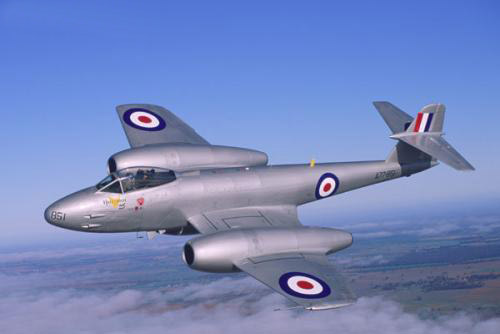
The Gloster Meteor was the first British jet fighter and the Allies' first operational jet. Designed by George Carter, it first flew in 1943 and commenced operations on 27 July 1944 with 616 Squadron of the Royal Air Force (RAF). The Gloster Meteor was not an aerodynamically advanced aircraft but the Gloster design team succeeded in producing an effective jet fighter that served the RAF and other air forces for decades.


The first British jet-powered aircraft, the single-engined Gloster E28/39 prototype, had its maiden flight on 15 May 1941. After several improvement on prototypes ,the first 20 aircraft were delivered to the Royal Air Force on 1 June 1944, one was also sent to the U.S. in exchange for a Bell YP-59A Airacomet for comparative evaluation. No. 616 Squadron RAF was the first to receive operational Meteors.


The Meteor was initially used to counter the V-1 flying bomb threat. 616 Squadron Meteors saw action for the first time on 27 July 1944, when three aircraft were active over Kent. These were the Meteor's (and the Royal Air Force's) first operational jet combat missions. After some problems, especially with jamming guns, the first two V1 "kills" were made on 4 August. By war's end, Meteors accounted for 14 flying bombs.

Production of the Meteor continued until 1954 with almost 3,900 made, mainly the F.8 variant. As the Meteor was progressively relegated to secondary duties in later years, target tug, drone and specialized test vehicles were added to the diverse roles that this first-generation jet fighter took on.


General characteristics
  • Crew: 1
  • Length: 44 ft 7 in (13.59 m)
  • Wingspan: 37 ft 2 in (11.32 m)
  • Height: 13 ft 0 in (3.96 m)
  • Wing area: 350 ft² (32.52 m²)
  • Empty weight: 10,684 lb (4,846 kg)
  • Loaded weight: 15,700 lb (7,121 kg)
  • Powerplant: 2 × Rolls-Royce Derwent 8 turbojets, 3,500 lbf (15.6 kN) each

Performance
  • Maximum speed: 600 mph (522 knots, 965 km/h, Mach 0.82) at 10,000 ft (3,050 m)
  • Range: 600 mi (522 nmi, 965 km)
  • Service ceiling: 43,000 ft (13,100 m)
  • Rate of climb: 7,000 ft/min (35.6 m/s)
  • Wing loading: 44.9 lb/ft² (149 kg/m²)
  • Thrust/weight: 0.45
  • Time to altitude: 5.0 min to 30,000 ft (9,145 m)

Armament
  • 4 × 20 mm British Hispano cannons
  • Provision for up to sixteen "60lb" 3 in rockets under outer wings

** Gloster Meteor - Warbird Fare

Facebook Twitter Stumbleupon Delicious Digg More Favorites

 
Back To Top